AI workflow vs agentic system
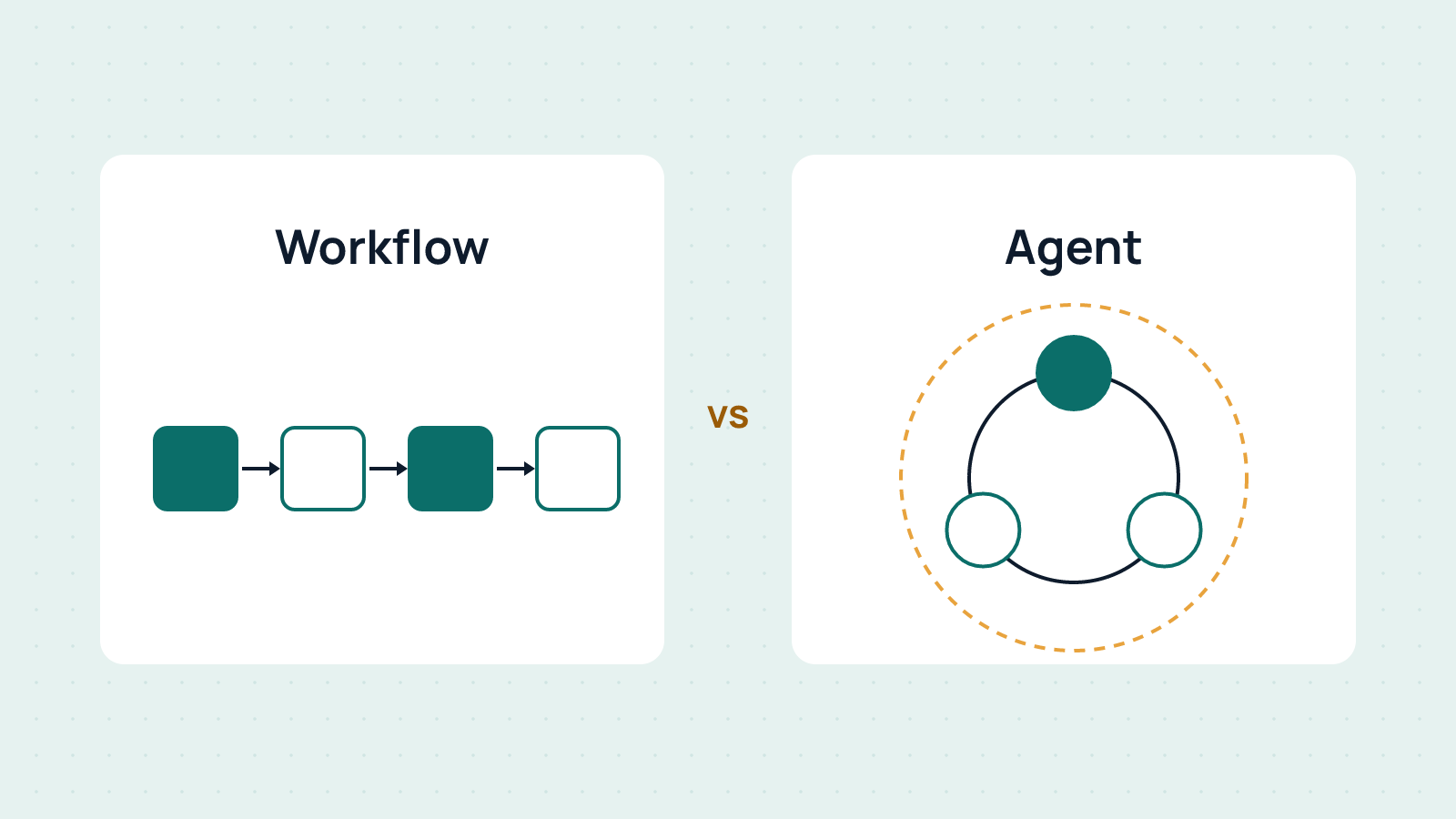
In short: an AI workflow runs steps that someone decided in advance, in code. An agentic system lets the model decide what to do next, step by step, until the task is done. Workflows are predictable and cheap to run; agents can handle open-ended tasks, but cost more and need guardrails.
AI workflow
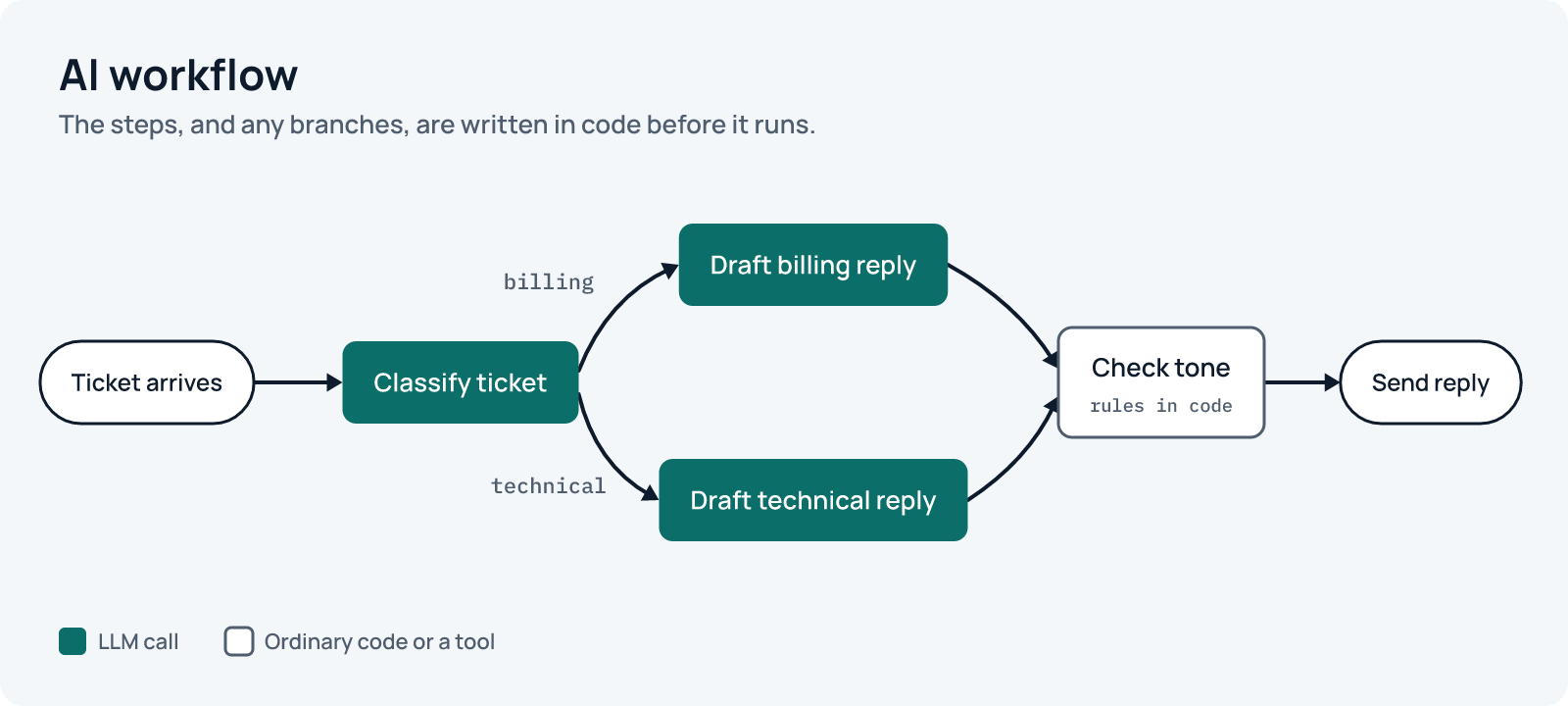
An AI workflow is a fixed sequence of steps. Some steps call a large language model (LLM); others are ordinary code. A developer writes the path through those steps before the system ever runs.
Workflows can still branch. A model might label a support ticket “billing” or “technical”, but both paths, and what happens on each, already exist in the code. The model picks a label; it cannot invent a new step.
Common workflow patterns
- Prompt chaining: each step works on the previous step’s output, such as outline, then draft, then edit.
- Routing: classify the input, then send it to the step built for that kind of input.
- Parallel steps: run independent parts at the same time, or ask several times and compare the answers.
Good for: tasks you can describe step by step in advance. Workflows are easier to test, debug and cost out, because every run follows a path you wrote.
Agentic system
In an agentic system, often just called an agent, the model directs its own process. It gets a goal and a set of tools, then works in a loop: decide the next action, use a tool, look at the result, and decide again. It stops when the goal is met or a limit stops it.
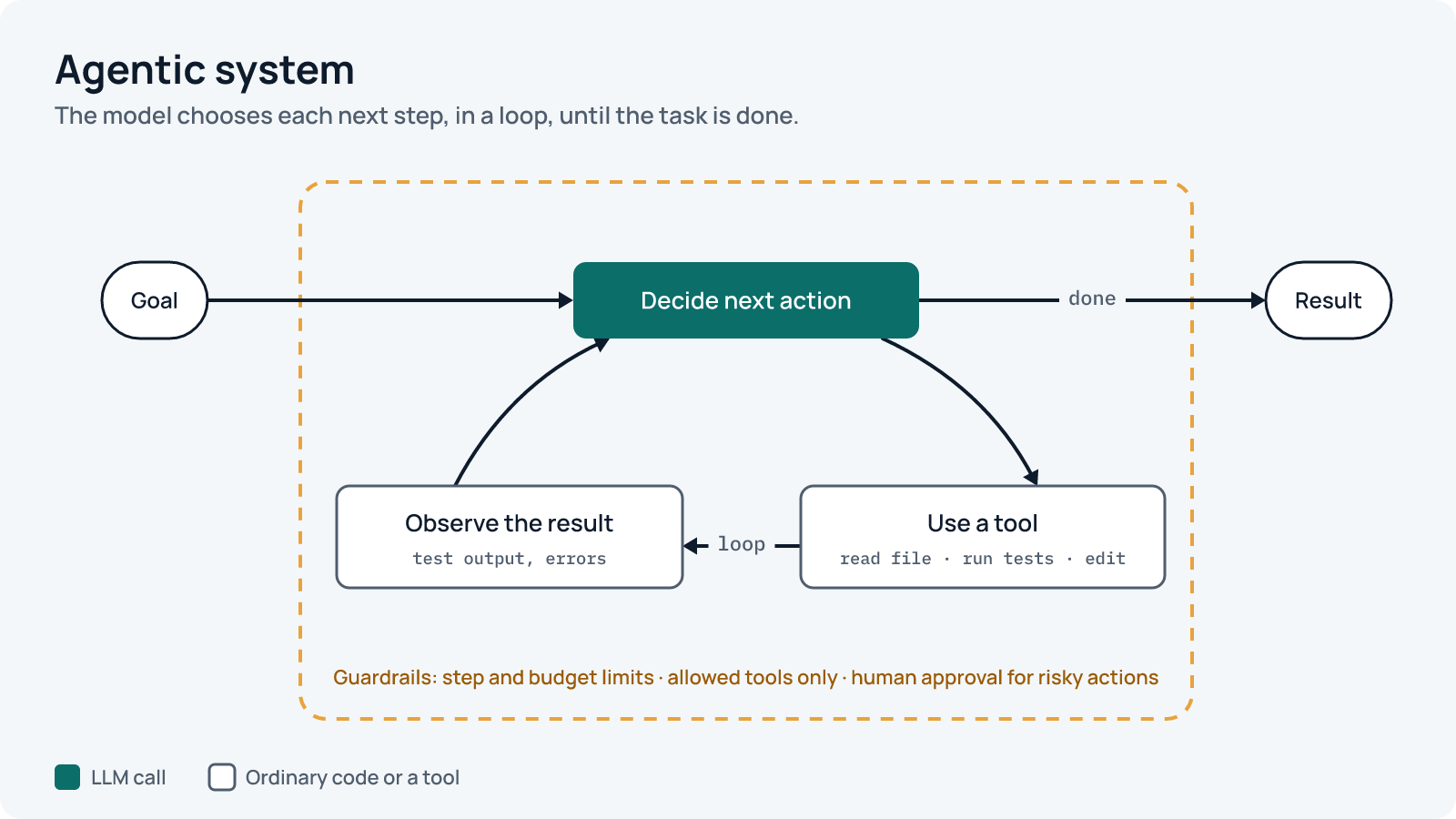
Because the model reacts to what it sees, an agent can handle situations nobody planned for, such as trying a different fix when the first one does not make the tests pass. That flexibility has a price:
- Cost and speed: every turn of the loop is another model call, so runs take longer, cost more, and are hard to estimate in advance.
- Compounding errors: a wrong decision early on feeds every step after it.
- Harder testing: two runs of the same task can take different paths.
Guardrails
Agents need limits that the model cannot override:
- a maximum number of steps, and a time or cost budget for each run;
- only the tools the task needs, with the narrowest permissions that work;
- human approval before anything risky or irreversible, such as sending email, spending money or deleting data;
- a log of every step, so you can see what the agent did and why;
- testing in a sandbox before it touches real systems.
Side by side
| AI workflow | Agentic system | |
|---|---|---|
| Who decides the next step | Your code | The model |
| Path through the task | Fixed in advance, branches included | Chosen while it runs |
| Predictability | High | Lower; runs can differ |
| Cost and speed | Lower, and easy to estimate | Higher, and varies from run to run |
| Testing and debugging | Straightforward | Needs step logs, evaluations and limits |
| Best for | Well-defined, repeatable tasks | Open-ended tasks whose steps cannot be known in advance |
Which should you use?
Start with the simplest thing that works. Often a single, well-prompted model call is enough. If a task has clear, known steps, build a workflow. Reach for an agent only when the steps genuinely cannot be planned in advance and the result is worth the extra cost and risk.
The two also combine. A workflow can hand one open-ended step to an agent, and an agent can call a well-tested workflow as one of its tools.
Tools for building them
You can build either kind in plain code: a model API, a few functions and, for an agent, a loop. Frameworks such as LangChain and LangGraph provide ready-made pieces for model calls, tools and agent loops; LangGraph lays a system out as a graph of steps, which suits both fixed workflows and agents. Use a framework when it makes your system easier to understand, not by default.
Further reading
- Anthropic, Building effective agents (December 2024): the workflow and agent definitions this entry follows.
- LangChain, Workflows and agents (LangGraph documentation).
Comments